Selecting the appropriate air distribution system is one of the most important decisions in the design of a commercial HVAC system. Two of the most common approaches are Constant Air Volume (CAV) and Variable Air Volume (VAV) systems. While both are designed to maintain comfortable indoor conditions, they achieve this objective in fundamentally different ways.
Understanding the advantages, disadvantages, and appropriate applications of each system is essential for mechanical engineers, contractors, and building owners.
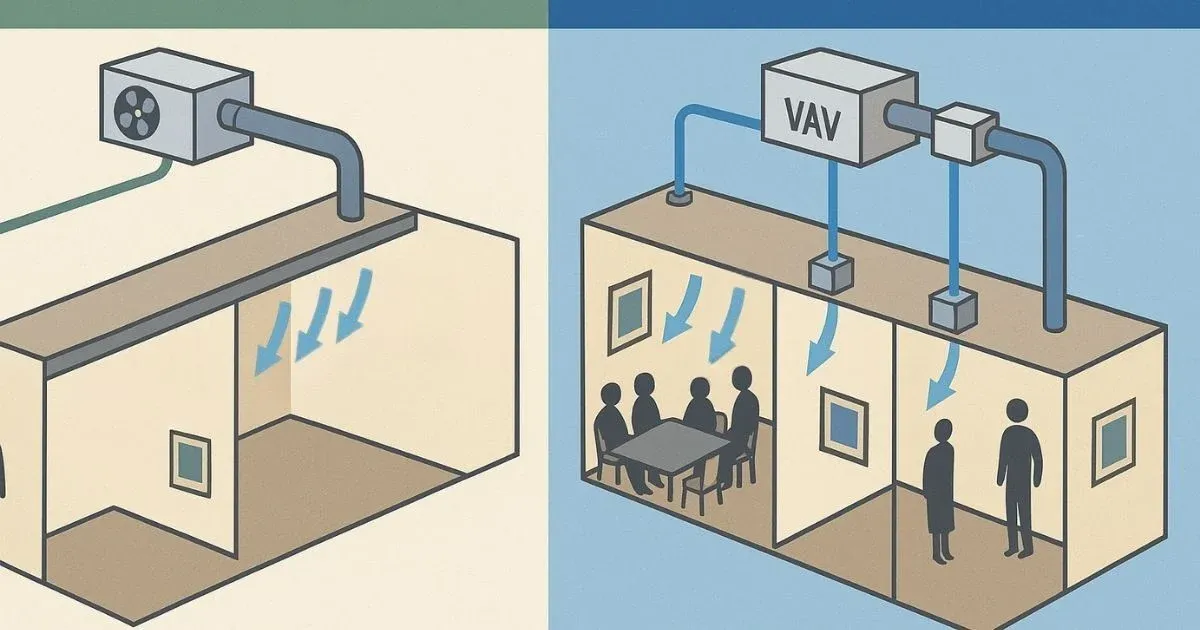
As the name suggests, a Constant Air Volume system supplies a fixed airflow rate to each conditioned space. When the cooling or heating demand changes, the supply air temperature is adjusted while the airflow remains essentially constant.
A typical CAV system consists of an air handling unit (AHU), ductwork, diffusers, and terminal devices. The supply fan operates at a constant speed, delivering the design airflow regardless of the building load.
For example, if an office requires 2,000 CFM at peak cooling conditions, the AHU will continue supplying approximately 2,000 CFM throughout the day. During periods of reduced cooling demand, the supply air temperature is increased to prevent overcooling.
This simplicity makes CAV systems relatively easy to design, install, commission, and maintain, as well as being generally lower in cost.
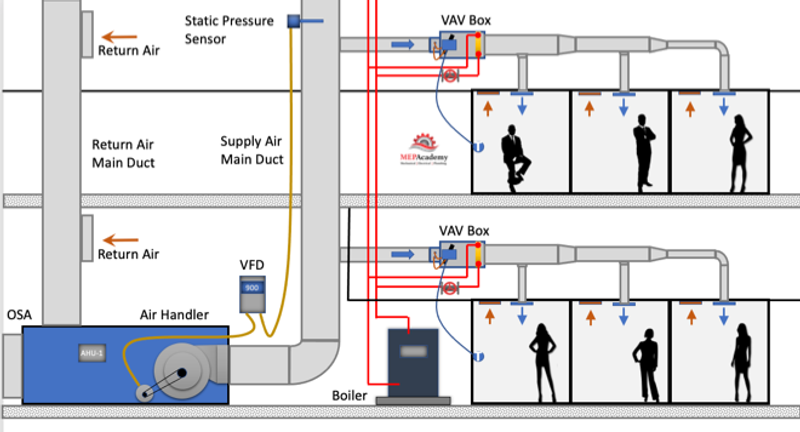
A Variable Air Volume system takes a different approach. Rather than maintaining constant airflow, the supply air temperature is held nearly constant - although sometimes changing seasonally - while the airflow delivered to each zone varies according to the space load.
Each zone is equipped with a VAV terminal box that modulates a damper to regulate airflow. As the cooling load decreases, the damper closes, reducing the amount of conditioned air delivered to the space. When the cooling load increases, the damper opens to provide additional airflow.
The supply fan is typically controlled by a Variable Frequency Drive (VFD), allowing the fan speed to decrease as the overall airflow demand drops. Because fan power varies approximately with the cube of airflow, even modest reductions in airflow can produce significant energy savings.
One of the primary reasons VAV systems have become the standard for most commercial buildings is their superior energy performance.
Commercial buildings rarely operate at peak load for extended periods. Internal gains from occupants, lighting, equipment, and solar radiation fluctuate throughout the day, resulting in changing cooling requirements.
A CAV system continues delivering full design airflow regardless of these changing loads. Although the supply air temperature is adjusted (unless the system is overly simple, such as a packaged RTU), the supply fan still consumes nearly the same amount of power.
In contrast, a VAV system reduces airflow whenever possible. Lower airflow reduces fan energy consumption and often decreases reheat energy, resulting in lower operating costs over the life of the building.
For large office buildings, schools, and institutional facilities, these energy savings can be substantial.
Another significant advantage of VAV systems is their ability to accommodate multiple thermal zones.
Different areas of a building frequently experience different loads. South-facing offices may require cooling while north-facing offices require little or no cooling. Conference rooms can experience rapid load increases during meetings, while adjacent offices remain lightly occupied.
A CAV system serving multiple spaces generally struggles to satisfy these varying conditions because each zone receives the same airflow.
A VAV system allows each terminal box to respond independently to local thermostat requirements. This provides more consistent occupant comfort while reducing unnecessary conditioning of lightly loaded spaces.
The additional flexibility of VAV systems comes at the cost of increased complexity.
A CAV system contains relatively few control components, making installation straightforward and reducing maintenance requirements. Troubleshooting is also generally simpler because fewer devices can fail.
VAV systems require additional equipment, including:
These components require proper commissioning to ensure stable operation. Poorly tuned control sequences can lead to unstable duct pressures, excessive fan energy, or occupant comfort complaints.
For this reason, VAV systems typically demand greater attention during startup and commissioning than comparable CAV installations.
CAV systems remain appropriate for buildings where airflow requirements remain relatively constant throughout the day.
Examples include:
VAV systems are generally preferred for larger commercial buildings with multiple occupied zones and highly variable internal loads.
Common applications include:
In many jurisdictions, modern energy codes also encourage or require variable air volume systems for larger commercial buildings due to their improved energy efficiency.
Neither system is universally better. The appropriate choice depends on the building type, occupancy patterns, first cost, operating cost, and project requirements.
For smaller buildings with simple layouts and relatively constant loads, the lower installation cost and reduced maintenance requirements of a CAV system may outweigh its higher energy consumption.
For larger commercial buildings with multiple thermal zones, VAV systems generally provide better comfort, improved energy performance, and lower life-cycle costs despite their higher initial complexity.
As with any HVAC design decision, system selection should be based on a detailed analysis of the building’s expected operating conditions rather than relying on standard practice alone. An accurate heating and cooling load calculation is the foundation of that analysis and provides the information needed to size equipment and evaluate whether a CAV or VAV system is the better long-term solution.