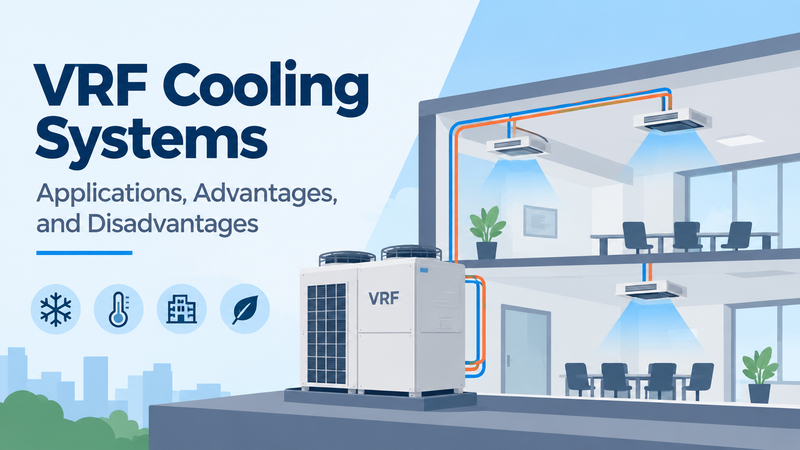
Variable refrigerant flow (VRF) systems have become an established option for commercial HVAC applications in the United States. Unlike conventional chilled-water systems, rooftop units, or traditional split systems, VRF systems distribute refrigerant directly to multiple indoor units, allowing the capacity delivered to individual zones to vary according to the current load.
For mechanical engineers and HVAC contractors, VRF can offer a different approach to zoning, equipment distribution, controls, and system installation. However, it also introduces considerations involving refrigerant piping, ventilation, controls, equipment selection, and maintenance.
This article provides an overview of VRF cooling systems, including how they operate, where they are typically used, and the primary advantages and disadvantages that should be considered during system selection.
VRF, or variable refrigerant flow, is a type of direct-expansion (DX) HVAC system in which one or more outdoor condensing units are connected to multiple indoor units through a network of refrigerant piping.
The fundamental concept is similar to a conventional heat pump or split air-conditioning system. The difference is that a VRF system can serve many indoor zones from a common outdoor system while continuously modulating the amount of refrigerant supplied to each indoor unit.
A typical system consists of:
The outdoor unit adjusts compressor capacity based on the combined demand of the connected indoor units. At the same time, the individual indoor units regulate their own refrigerant flow according to the load in their respective zones.
This allows a VRF system to operate at considerably less than its maximum capacity when the building does not require full cooling output.
There are several configurations of VRF systems, but two are particularly common in commercial applications: heat pump VRF and heat recovery VRF.
A heat pump VRF system can provide heating or cooling, but the connected indoor units generally operate in the same overall mode. In other words, the system cannot normally have one zone cooling while another zone is heating at the same time.
A heat recovery VRF system adds the ability to provide simultaneous heating and cooling. Heat removed from a zone requiring cooling can be transferred through the refrigerant circuit and used to heat another zone.
This can be useful in buildings where different zones regularly have opposing loads, such as offices with significant solar exposure on one side of the building and perimeter heating requirements on another.
During cooling operation, the outdoor unit rejects heat to the outdoor environment while refrigerant circulates through the building to the indoor units.
Each indoor unit has its own electronic expansion valve. The valve modulates refrigerant flow according to the requirements of the individual zone. As the cooling load changes, the system adjusts compressor capacity and refrigerant flow accordingly.
For example, consider an office building with several perimeter offices:
Rather than supplying a fixed amount of chilled water or conditioned air to each zone, a VRF system can continuously adjust refrigerant flow to respond to these changing loads.
This variable-capacity operation is one of the fundamental characteristics of VRF technology.
VRF systems are used across a broad range of commercial and institutional applications. They are particularly suited to buildings where individual zone control is important and where a conventional central air-handling system may not be the preferred approach.
Common applications include:
VRF is frequently considered for offices with numerous individual rooms or relatively small zones.
Individual indoor units allow occupants or building operators to control temperatures independently. This can be particularly useful where occupancy and internal loads vary significantly between spaces.
Hotels are another common application because each guest room represents a relatively independent thermal zone.
A VRF system can provide individual temperature control to each room while reducing the amount of large central ductwork required.
Similar characteristics apply to apartments and condominiums. Individual dwelling units can be served by separate indoor units while outdoor equipment is shared across groups of spaces.
VRF can also be used in retail stores, restaurants, and similar commercial spaces where occupancy and cooling loads can vary substantially throughout the day.
The relatively small refrigerant piping and distributed nature of VRF can be useful in renovation projects where installing large ductwork or new chilled-water piping would be difficult.
Historical buildings and other buildings with architectural constraints can therefore be candidates for VRF systems.
VRF is not inherently the right choice for every building, but it has several characteristics that can make it attractive for certain applications.
One of the primary advantages of VRF is the ability to control individual zones independently.
Instead of operating a large central system serving many spaces, each indoor unit can respond to the load in its own zone.
This can be advantageous in buildings with:
VRF systems can modulate their capacity to match the building load.
This is different from simply cycling a fixed-capacity compressor on and off. Variable-speed compressors and electronic expansion valves allow the system to adjust refrigerant flow and compressor output as conditions change.
Part-load operation can therefore be an important consideration when evaluating VRF energy performance. However, actual energy consumption depends on the building, climate, equipment selection, operating schedule, controls, and other system characteristics.
Heat recovery VRF systems can provide simultaneous heating and cooling.
This can create an opportunity to transfer heat from zones requiring cooling to zones requiring heating rather than rejecting all of that heat outdoors.
For buildings with significant simultaneous heating and cooling loads, this can be an important system-selection consideration.
Because VRF systems distribute refrigerant rather than conditioned air from a central air handler, they can substantially reduce the amount of supply and return ductwork required for space conditioning.
This can be useful in buildings with limited ceiling space or complicated architectural layouts.
It does not, however, eliminate the need for ductwork altogether. Ventilation air still needs to be provided where required, and VRF systems are commonly paired with a dedicated outdoor air system (DOAS) for ventilation.
VRF manufacturers offer a variety of indoor unit configurations, including ducted and non-ducted units.
This allows the designer to select equipment appropriate for different architectural conditions rather than using the same terminal unit throughout the entire building.
VRF systems are relatively modular. Multiple outdoor units and indoor units can be arranged to serve different portions of a building.
This can reduce the dependence on a single large central piece of cooling equipment and can provide additional flexibility in buildings where mechanical-room space is limited.
The characteristics that make VRF attractive also introduce some limitations. These should be evaluated during the design process rather than treating VRF as a universal replacement for conventional HVAC systems.
A VRF system may involve substantial amounts of refrigerant piping, branch connections, joints, and controls.
As system size increases, the design becomes increasingly dependent on manufacturer-specific requirements for:
The piping system is therefore a critical part of the equipment design rather than simply a field-installed connection between two pieces of equipment.
A common misconception is that installing VRF eliminates the need to deal with ventilation.
It does not.
VRF indoor units primarily handle the sensible and latent loads associated with the conditioned space. They do not automatically provide the required amount of outdoor air for the building.
For commercial buildings subject to ASHRAE Standard 62.1, ventilation requirements still need to be addressed. A common approach is to pair the VRF system with a DOAS that handles the required outdoor air independently of the space-conditioning equipment.
This means that a complete VRF design may actually involve two separate HVAC systems:
The interaction between the two systems also needs to be considered during load calculations and controls design.
VRF systems can contain substantially more refrigerant than a conventional single-zone split system because one outdoor unit may serve numerous indoor units through an extensive piping network.
As a result, refrigerant charge and potential refrigerant concentration in occupied spaces need to be considered during system design.
The applicable codes, standards, equipment requirements, and refrigerant characteristics should be reviewed for the specific project.
This issue has become increasingly important as the industry transitions toward lower-GWP refrigerants and equipment using different refrigerant classifications.
VRF systems are highly dependent on proprietary controls.
Outdoor units, indoor units, branch controllers, thermostats, and other components typically communicate using manufacturer-specific protocols.
Integration with a building automation system is possible, but the method and capabilities can vary between manufacturers.
For engineers and contractors, this can mean that VRF design requires closer coordination with the manufacturer’s equipment selection software and technical documentation than some conventional HVAC systems.
A conventional DX system already requires technicians with refrigeration expertise. VRF systems can add another layer of complexity because of their distributed architecture and control system.
Troubleshooting may involve:
Contractors servicing VRF equipment therefore need appropriate training and familiarity with the specific manufacturer’s system.
One potential disadvantage of VRF compared with some conventional air-side systems is that the VRF system itself does not provide the same type of free cooling that can be achieved with an air-side economizer.
A conventional air-handling system can sometimes use favorable outdoor conditions to reduce or eliminate compressor cooling.
With VRF, ventilation and conditioning are generally handled separately, so the designer needs to evaluate whether an economizer or other method of utilizing favorable outdoor conditions is appropriate for the application.
For projects using VRF for heating as well as cooling, climate needs to be considered carefully.
Air-source VRF heat pumps lose heating capacity as outdoor temperature decreases. The extent of this reduction depends on the particular equipment and manufacturer.
Supplemental heating, appropriate equipment selection, or other strategies may be required for heating-dominant applications in colder climates.
This is particularly relevant when considering VRF for buildings where the system is expected to provide essentially the entire heating load.
It is difficult to make a general statement that VRF is cheaper or more expensive than a conventional HVAC system.
The comparison depends on the alternatives being considered and the characteristics of the building.
Relevant factors include:
The appropriate comparison should consider both initial construction costs and expected operating and maintenance costs over the life of the system.
VRF is best understood as another tool available to the HVAC designer rather than a replacement for every other system type.
For example, a centralized chilled-water system may make sense for a large building with substantial cooling loads and centralized mechanical infrastructure. A VAV system may be attractive where ventilation and air distribution are major components of the design.
A VRF system may be particularly applicable when the project has many relatively independent zones, limited space for large duct systems, and a requirement for individual zone control.
The following table summarizes some of the major differences:
| Characteristic | VRF | Central Chilled Water / VAV |
|---|---|---|
| Zone control | Highly decentralized | Typically centralized |
| Cooling distribution | Refrigerant piping | Chilled water and/or air |
| Ductwork | Often reduced | Typically substantial |
| Ventilation | Usually separate | Often integrated with AHU |
| Part-load operation | Variable refrigerant flow | Variable water/air flow depending on system |
| Simultaneous heating/cooling | Available with heat recovery | Commonly available with appropriate system design |
| Economizer operation | Requires separate consideration | Readily incorporated into air-side systems |
| Controls | Often manufacturer-specific | More commonly based around central BAS components |
| Refrigerant quantity | Potentially significant | Primarily contained within chiller/DX equipment |
| Best suited to | Many independent zones and distributed applications | Larger centralized systems and applications requiring substantial air distribution |
This comparison is intentionally general. A properly designed system of either type can have very different characteristics depending on equipment selection, controls, climate, building loads, and operating requirements.
VRF does not eliminate the need for accurate heating and cooling load calculations.
In fact, the highly zoned nature of VRF makes accurate zone loads particularly important. Each indoor unit needs to be selected based on the requirements of its specific zone, while the overall system also needs to account for diversity and the manufacturer’s allowable combinations of indoor and outdoor equipment.
The designer should consider:
For heat recovery systems, the timing and magnitude of heating and cooling loads can be particularly important because the potential benefit of heat recovery depends on whether suitable simultaneous loads actually exist.
This is one reason why equipment selection should not simply be based on adding up the nominal capacities of individual indoor units.
There is no universal answer.
VRF can be a practical solution for buildings with numerous independently controlled zones, limited space for ductwork, and operating conditions that make variable-capacity equipment and, where applicable, heat recovery attractive.
At the same time, the technology introduces additional considerations involving refrigerant piping, ventilation, controls, refrigerant concentration, maintenance, and equipment selection.
The appropriate approach is to evaluate VRF alongside the other systems that are technically viable for the project and compare them using the actual building loads, climate, operating schedule, installation requirements, and life-cycle costs.
For mechanical engineers and contractors, VRF is best viewed as a system architecture with particular strengths and limitations, rather than as a universally superior or inferior HVAC technology.
Variable refrigerant flow systems provide a way to distribute heating and cooling through refrigerant piping while allowing multiple indoor units to operate at variable capacities.
Their primary characteristics include individual zone control, variable-capacity operation, reduced ductwork, distributed equipment, and the potential for simultaneous heating and cooling through heat recovery.
These characteristics can make VRF useful in offices, hotels, multifamily buildings, retail facilities, and other buildings with numerous independent zones.
However, VRF also requires careful consideration of refrigerant piping, ventilation, refrigerant concentration, controls, maintenance, cold-weather performance, and life-cycle cost.
As with any HVAC system, the appropriate choice depends on the specific building rather than on the technology alone. A sound system selection process should begin with the building loads and operating requirements and then compare the available HVAC system options against those requirements.