For commercial HVAC engineers and contractors, comfort cooling is rarely just about lowering the temperature. In modern commercial buildings—characterized by high occupancy densities, heavy ventilation requirements, and tight building envelopes—managing moisture is often a greater challenge than managing heat.
To design, install, and troubleshoot systems that successfully balance both temperature and humidity, professionals must master a critical metric: the Sensible Heat Ratio (SHR).
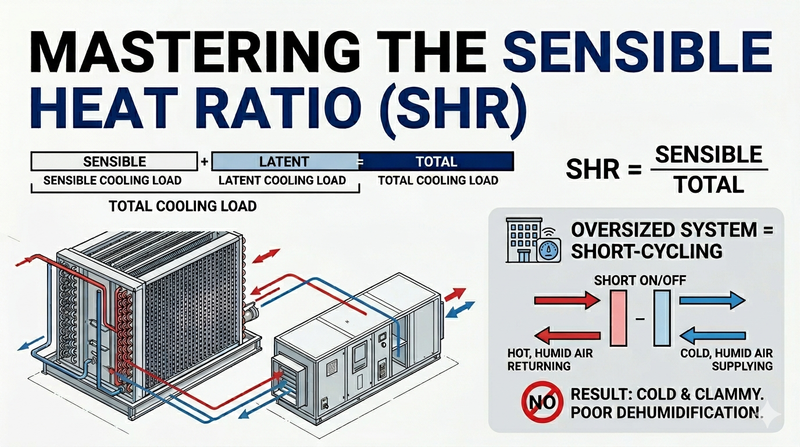
At its core, the total cooling load of a building space is divided into two distinct components:
The Sensible Heat Ratio is the mathematical relationship between the sensible cooling load and the total cooling load (sensible plus latent):
An SHR of 0.80 means that 80% of the cooling load is dedicated to lowering the air temperature (sensible), while 20% is dedicated to removing moisture from the air (latent).
Consider a modern corporate office or a conference facility. The internal sensible loads from computers and LED lighting may be highly optimized and low, but the required outdoor air ventilation rates bring in massive amounts of ambient moisture, especially in humid climates. If a space has a high occupant density, the latent load spikes, driving the space characteristic SHR down (e.g., to 0.65 or 0.60). Conversely, a high-exposure retail zone with massive south-facing glass might have a very high sensible load, pushing the SHR closer to 0.85 or 0.90.
As an engineer, you must calculate the Space SHR during peak and part-load conditions, and then select equipment whose Apparatus SHR matches that requirement. If the equipment’s moisture-removal capability doesn’t align with the room’s actual moisture generation, the space will drift outside the comfort zone.
The most critical design consideration affected by SHR is equipment sizing, particularly under part-load conditions.
Most commercial HVAC systems are controlled by a standard space thermostat. Thermostats are inherently sensible-driven devices; they measure dry-bulb temperature, not relative humidity. When the space temperature rises above the setpoint, the thermostat calls for cooling, opening a chilled water valve or staging on a direct expansion (DX) compressor. Once the dry-bulb temperature drops to the setpoint, the system satisfies and shuts down.
Herein lies the danger of the common industry sin: oversizing equipment.
When a DX rooftop unit (RTU) or split system is oversized, it possesses an excess of sensible cooling capacity. When it turns on, it rapidly drops the room’s dry-bulb temperature. Because the capacity is so high, the thermostat is satisfied in a fraction of the time it should take. This results in brief, frequent equipment cycles—a phenomenon known as short-cycling.
Dehumidification requires time. For a cooling coil to remove latent heat, the air passing over it must be cooled below its dew point. Moisture must condense out of the airstream, collect on the coil fins, and physically run down into the drain pan.
When a system short-cycles due to oversizing:
The result is a disastrous imbalance: the system delivers plenty of sensible cooling (the room is cold), but almost no latent cooling (the room is humid). Occupants are left in a cold, clammy environment that breeds mold, compromises indoor air quality, and ruins comfort.
To prevent the pitfalls of mismatched SHRs, commercial designers and contractors should pivot their strategies in three areas:
The Sensible Heat Ratio is not just a theoretical line on a psychrometric chart; it is a blueprint for real-world system performance. In commercial spaces where temperature control is the primary driver of equipment operation, oversized systems will inevitably fail the latent load test. By accurately calculating space SHR, avoiding safety margins that lead to oversizing, and selecting equipment capable of modulating capacity, HVAC professionals can deliver systems that are truly efficient, reliable, and comfortable year-round.