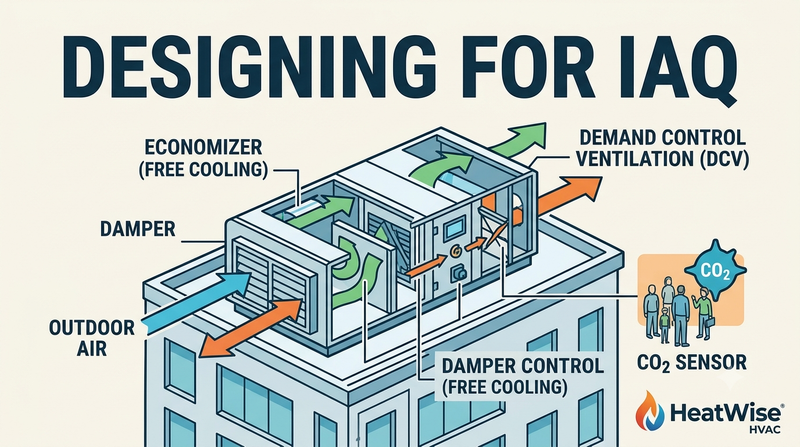
Designing ventilation systems for commercial buildings requires balancing two conflicting objectives: maintaining acceptable indoor air quality (IAQ) and minimizing energy consumption. Conditioning outdoor air—whether heating cold winter air, cooling humid summer air, or removing moisture—is one of the largest energy draws in commercial HVAC operations. However, restricting outdoor air intake causes contaminants, bio-effluents, and moisture to build up, leading to poor air quality and occupant discomfort.
For non-residential buildings, ASHRAE Standard 62.1, Ventilation for Acceptable Indoor Air Quality, serves as the primary benchmark for minimum outdoor air requirements. Over successive revisions, the standard has evolved to provide engineers with flexible compliance paths and control strategies that maintain indoor air quality while reducing unnecessary energy expenditure.
To comply with ASHRAE 62.1, engineers generally choose between two primary design approaches: the Ventilation Rate Procedure (VRP) and the Indoor Air Quality Procedure (IAQP).
The VRP is a prescriptive calculation method. It determines outdoor airflow rates based on two primary load drivers: occupant density and floor area. The breathing zone outdoor airflow () is calculated using the standard formula:
Where:
The VRP is straightforward, deterministic, and widely accepted by code officials. Because it relies on static default occupancy values and prescriptive tables, it simplifies the design phase. However, this simplicity can lead to over-ventilation during off-peak hours or in spaces with fluctuating occupancy (such as auditoriums, conference rooms, or classrooms).
For a step-by-step breakdown of executing the VRP equations and multi-zone system calculations, see our previous blog post on ASHRAE 62.1 Ventilation Calculations.
The IAQP is a performance-based design methodology. Instead of prescribing volumetric airflow rates based solely on space type, the IAQP requires the designer to identify specific contaminants of concern (such as formaldehyde, TVOCs, and carbon dioxide), establish target concentration limits, and calculate the required outdoor air and air cleaning efficiency needed to maintain those limits.
By utilizing high-efficiency gas-phase air cleaning (such as sorbent filters or carbon scrubbers) alongside particulate filtration, the IAQP allows engineers to reduce required outdoor air intake below standard VRP rates while maintaining equivalent or superior indoor air quality. The trade-off is computational and analytical complexity: the designer must model contaminant generation rates and evaluate air-cleaning equipment efficiency across the operating envelope.
While ventilation air typically represents an energy penalty, there are times when outdoor air can cool the building without running mechanical compressors. This process is known as airside economizing, or “free cooling.”
An airside economizer consists of a set of linked, motorized dampers—outdoor air, return air, and relief air—controlled by the air handling unit (AHU) automation system.
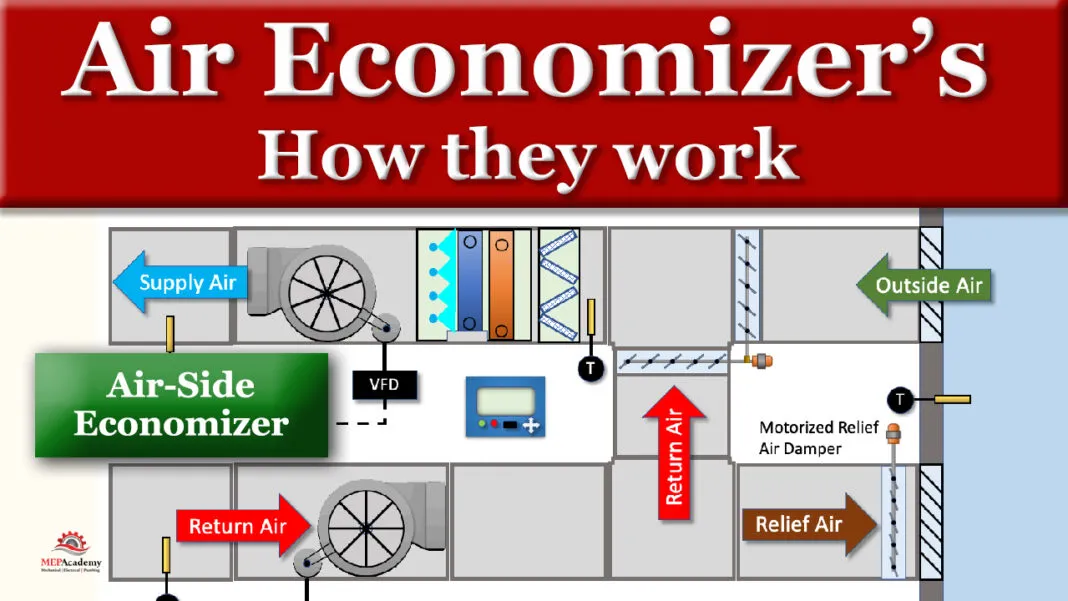
When outdoor air conditions are favorable, the economizer sequences the dampers to draw in up to 100% outdoor air to satisfy space cooling loads:
In internal-load-dominated commercial buildings—where lighting, computers, and occupants create a net cooling load even when outdoor temperatures are in the 40s or 50s Fahrenheit—an economizer drastically reduces compressor runtime and annual electrical consumption.
Under standard VRP design, minimum outdoor air damper positions are set based on design peak occupancy. However, most commercial spaces operate at peak occupancy for only a fraction of the day. Conditioning 100% of peak outdoor air in a half-empty room wastes significant energy.
Demand Control Ventilation (DCV) solves this by automatically adjusting outdoor air intake in real time based on actual space population.
Because humans exhale carbon dioxide () at a relatively constant rate based on activity level, indoor concentration acts as a reliable surrogate for occupant density. A typical DCV control loop operates as follows:
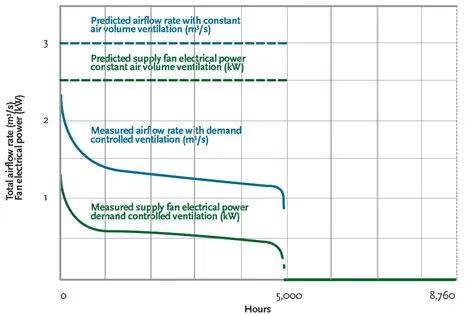
A common control design consideration is how DCV interacts with an airside economizer:
Balancing indoor air quality with energy performance requires selecting the right calculation methodology and control strategies for the application:
[1] American Society of Heating, Refrigeration, and Air Conditioning Engineers. 2022. ANSI/ASHRAE Standard 62.1-2022: Ventilation for Acceptable Indoor Air Quality. Atlanta, GA: ASHRAE.
[2] American Society of Heating, Refrigeration, and Air Conditioning Engineers. 2021. “Chapter 16: Ventilation and Infiltration.” In 2021 Fundamentals Handbook. Atlanta, GA: ASHRAE.
[3] MEP Academy. March 15, 2023. How and Air Side Economizer Works. https://mepacademy.com/how-an-air-side-economizer-works/.
[4] CIBSE Journal. Module 45: Demand-controlled ventilation to reduce fan energy use. October, 2012. https://www.cibsejournal.com/cpd/modules/2012-10/.