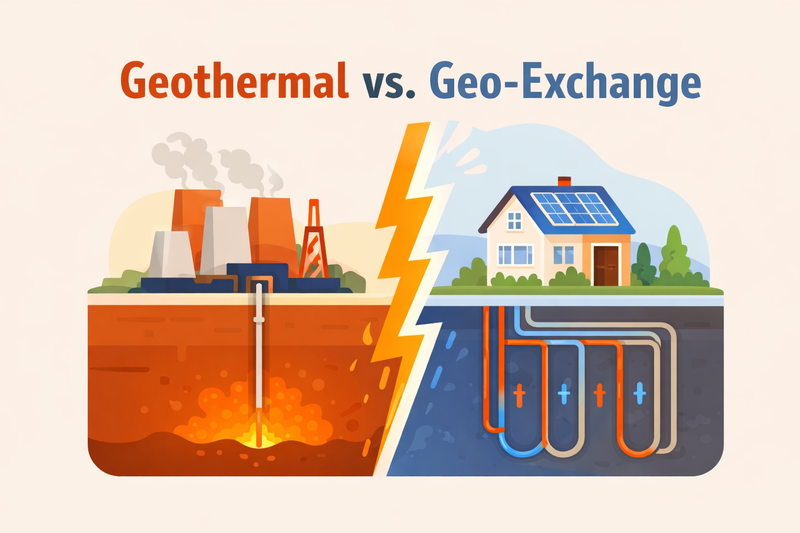
If you’ve heard a contractor talk about installing “geothermal” in your home, chances are they were actually talking about geo-exchange, also known as a Ground-Source Heat Pump (GSHP) system.
The terms are often used interchangeably, but in the world of energy, they represent two vastly different technologies that operate at completely different scales and temperatures. Understanding the distinction is crucial for any engineer, designer, or homeowner committed to sustainable energy.
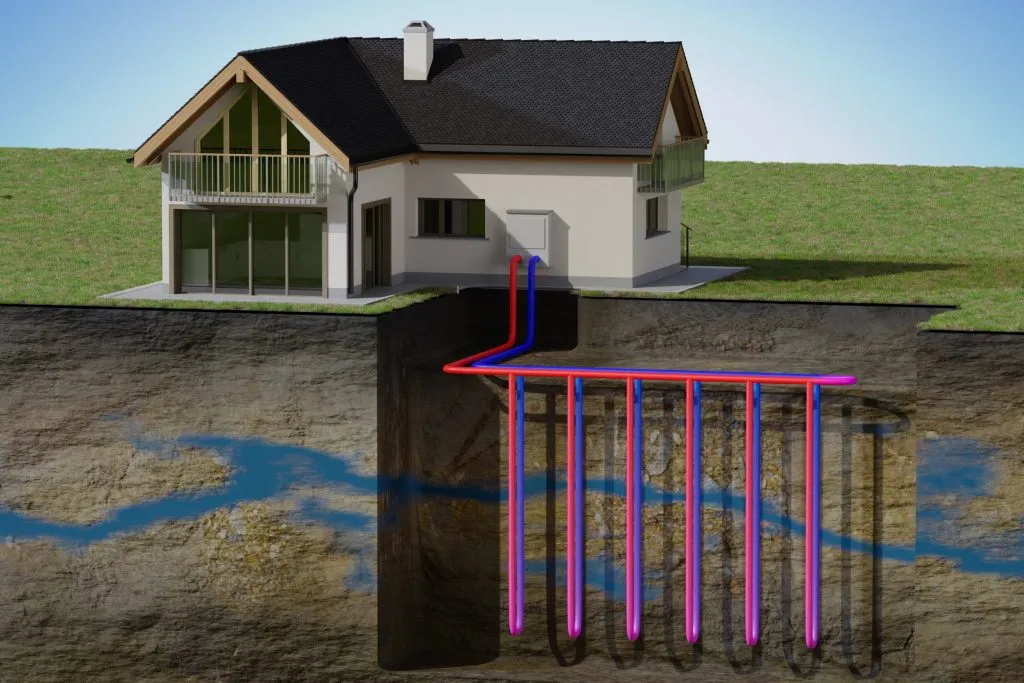
Geo-exchange systems, or Ground-Source Heat Pumps (GSHPs), are an efficient way to heat and cool buildings. They rely on the fact that the earth just a few feet below the surface maintains a relatively constant temperature year-round (typically between 45°F and 75°F / 7°C and 24°C, depending on your location).
Function: The system uses a heat pump and a network of underground pipes (loops) filled with a water-antifreeze mixture.
In winter, the fluid absorbs the stable heat from the ground and transfers it into the building. The ground acts as a energy source.
In summer, the system reverses, pulling excess heat from the building and transferring (or rejecting) it into the cooler ground. The ground acts as a heat sink.
Energy: The system runs on electricity, but it’s highly efficient because it only moves heat, rather than generating it by burning fuel.
Scale: Primarily used for residential and commercial heating and cooling.
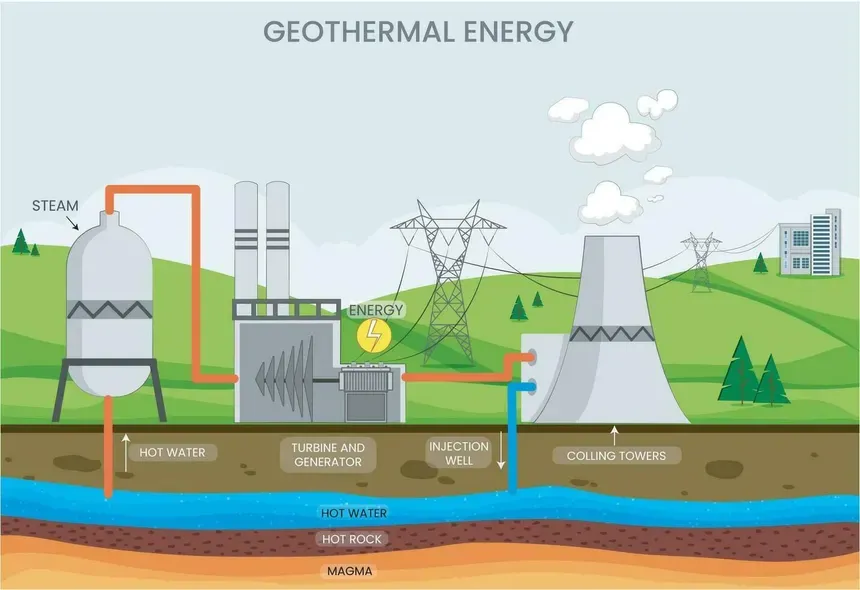
Geothermal energy refers to harnessing the powerful, high-temperature heat generated deep within the Earth’s crust—often near tectonically active areas. This is a utility-scale technology focused on large-scale power generation.
Function: Geothermal power plants drill deep wells (often miles down) into underground reservoirs of hot water and steam, where temperatures can exceed ().
Energy: The energy source is the Earth’s magmatic heat and radioactive decay, making it a powerful, constantly available renewable energy source (base-load power).
Scale: Used for electric power generation and large-scale heating networks (utility level).
While both technologies utilize the Earth’s heat, their differences in application and scale are significant:
| Feature | Geo-Exchange | True Geothermal Energy |
|---|---|---|
| Primary Purpose | Heating and Cooling (HVAC) | Electric Power Generation & Direct Heat |
| Depth | Shallow (10–500 feet) | Deep (1,000–15,000 feet) |
| Temperature | Low ( to ) | High (up to ) |
| Energy Role | The ground is a Source (winter) and Sink (summer) | The Earth is the direct Energy Source for power |
| Technology | Heat Pump, Closed/Open Ground Loop | Steam Turbine, Generator, Deep Drilling Rigs |
| Location | Usable almost anywhere | Limited to geologically active zones (tectonic plates) |
Both geo-exchange and geothermal energy are important parts of a sustainable future.
By using the correct terminology, we can better communicate the unique value and function of each powerful technology.
[2] https://www.pinterest.com/ideas/geothermal-power-plant-drawing/916783321451/