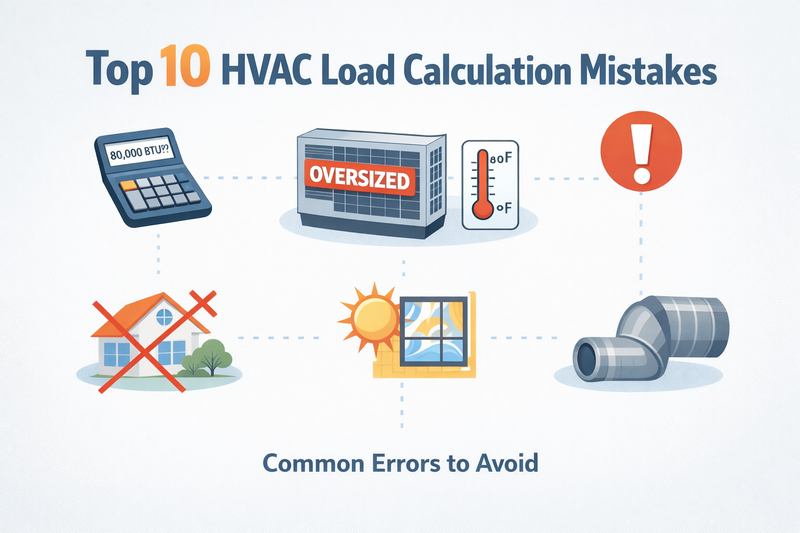
Accurate HVAC load calculations are the backbone of system design, yet even experienced contractors and engineers still run into costly errors. Oversized equipment, poor humidity control, short cycling, and uncomfortable spaces are often traced back to a handful of common issues. Below are some of the most frequent mistakes—and how to avoid them in practice.
Using “square footage × X BTUs” might be quick, but it ignores critical variables like insulation, glazing, orientation, and occupancy, which can be unique to every building. This often leads to oversized systems that short cycle and fail to control humidity properly.
For example, a rule of thumb could be “industry standard”, but if it was developed decades ago in a warm, humid climate and your building is in a cold, dry climate with modern construction materials, then your building load will be mismatched with the equipment selected.
The solution is to use a recognized methodology and proper software to base calculations on real inputs rather than assumptions. Even for smaller residential jobs, the difference may be significant.
One of the most common sources of error is underestimating how much the building envelope and air movement contribute to total load. Insulation levels, construction type, and especially infiltration can drastically change results.
In practice, two homes with identical layouts can have very different loads. A newer airtight home might have 0.2–0.3 ACH (air changes per hour), while an older home could exceed 0.8 ACH. That difference in infiltration can add thousands of BTUs to the heating and cooling load.
Instead of assuming “average construction,” use measured data when available (such as blower door results) or apply conservative but documented assumptions. Including ventilation requirements and infiltration properly ensures the system performs under real conditions.
Internal gains from people, lighting, and equipment are often overestimated, especially in commercial or mixed-use spaces.
For instance, a small office with 10 seats may assume that all seats are filled, all lights are on, and all equipment is on at full capacity, all the time. Instead, diversity factors should be used to account for the fact that such coincidental loads are rare, and when they do occur, they will not be occurring for long periods of time. Proper calculation procedures such as the Radiant Time Series (RTS) method can also ensure that the effect of building materials absorbing/releasing heat is properly accounted for.
To avoid this, account for realistic occupancy levels and actual equipment usage. In residential projects, this might be minor, but in offices, retail, or restaurants, internal loads can dominate the cooling requirement.
Oversizing is still one of the most persistent issues in HVAC design. Many systems are intentionally sized larger than necessary to avoid complaints, but this creates its own set of problems.
An oversized air conditioner, for example, may satisfy the thermostat quickly but won’t run long enough to remove humidity effectively. This leads to a space that feels cool but damp. It also increases wear on components due to frequent cycling.
A better approach is to trust the calculated load and select equipment accordingly using proper calculation software. If the calculated cooling load is 36,000 BTU, installing a 48,000 BTU unit “just in case” often results in worse performance, not better.
Compounding effects of inaccurate and overly conservative estimates of various factors is probably the most common error in HVAC load calculations. For example, if you over estimate the design day temperatures to add a safety factor, and then overestimate infiltration, and underestimate true building envelope performance, you will be adding safety factors that multiply together to create excessive oversizing of your equipment and duct sizing.
Load calculations often stop at the building envelope, but distribution losses can meaningfully impact system performance.
For example, ducts running through an unconditioned attic in winter can lose a noticeable amount of heat before it ever reaches the occupied space. Similarly, poorly sealed ducts can leak conditioned air, effectively increasing the required system capacity.
In practice, this means the equipment may be correctly sized on paper but still underperform in reality. Incorporating duct design principles and considering duct location and sealing quality helps bridge that gap.
Even when using structured methods, errors can still occur due to incorrect inputs or assumptions. Without a sanity check, these mistakes can go unnoticed.
For example, if a small, well-insulated home produces a calculated cooling load of 150,000 BTU, that should immediately raise a red flag. Similarly, unusually low loads in large or poorly insulated spaces should be questioned.
A good practice is to compare results against typical ranges and expectations. Many engineers will do a quick “napkin calc” check alongside a detailed calculation to ensure the numbers are reasonable. Using software can also help flag inconsistencies and standardize inputs.
Most HVAC load calculation mistakes don’t come from a lack of knowledge—they come from shortcuts, assumptions, and time pressure. Small errors in inputs or methodology can compound into significant performance issues once the system is installed.
The key is to build a repeatable and reliable process: use established standards, gather accurate data, and validate results before making equipment decisions. In many cases, leveraging dedicated HVAC load calculation software can reduce errors, improve consistency, and significantly speed up the workflow.
Done properly, accurate load calculations lead to better comfort, improved energy efficiency, and fewer callbacks—benefiting both contractors and clients alike.