How They Work, How They Handle Loads, and When They Make Sense
Chilled beam systems have become increasingly common in high-performance buildings, particularly in offices, laboratories, and institutional projects where energy efficiency, acoustic comfort, and ventilation control are priorities.
Unlike traditional all-air systems, chilled beams rely heavily on hydronic heat transfer to handle sensible loads while ventilation air is delivered separately. This fundamental difference changes how engineers must think about sensible vs. latent loads, air distribution, and system control.
This article explores the technical fundamentals of chilled beam systems, how they handle thermal loads, and when they are most advantageous in HVAC design.
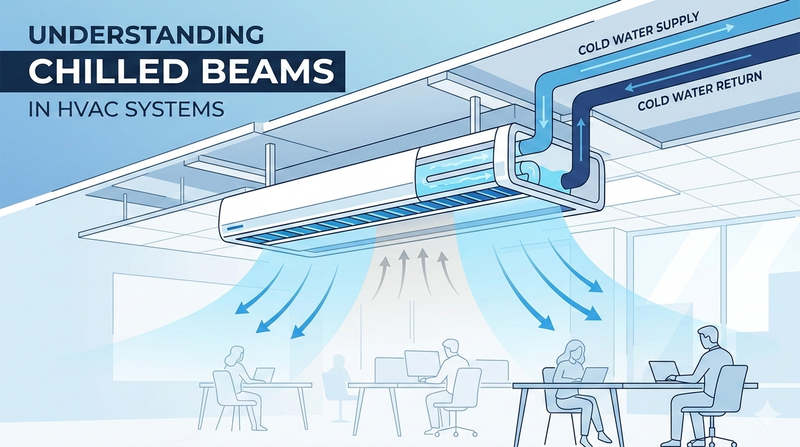
A chilled beam is a hydronic terminal unit installed near the ceiling that removes sensible heat from a space using chilled water flowing through a coil.
There are two main categories:
Passive chilled beams
Active chilled beams
Most modern commercial applications use active chilled beams because they integrate ventilation with sensible cooling.
Traditional VAV systems use air to deliver:
Chilled beam systems decouple these functions.
| Function | Delivered By |
|---|---|
| Ventilation | Primary air system |
| Latent cooling | Dedicated outdoor air system (DOAS) |
| Sensible cooling | Chilled beam water coil |
This allows a much smaller airflow rate than conventional systems.
In many buildings, airflow can be reduced to ventilation minimums rather than cooling-driven airflow rates.
Active chilled beams rely on air induction, similar in concept to induction diffusers.
Primary air is delivered through small nozzles at relatively high velocity. This creates a low-pressure region that pulls room air through the beam.
The process works as follows:
The ratio of induced air to primary air is called the induction ratio. Chilled beams can typically deliver cooling at 280-670 Btu/h per foot of beam (250–600 W per meter).
Because water has much higher heat capacity than air, chilled beams can move significant cooling loads with very small pumping energy compared to fan power in air systems.
Chilled beams are not designed to handle latent cooling at the beam itself. The chilled water temperature must remain above the room dew point to prevent condensation on the coil.
Typical chilled beam supply temperatures are 57oF – 61oF (14oC – 16oC). These temperatures are warmer than traditional chilled water systems. Therefore, all latent loads must handled through the air system by providing extra dry air removed upstream, typically by a Dedicated Outdoor Air System (DOAS).
The DOAS performs:
The supply air from the DOAS is must be delivered dry enough to maintain room dew points below beam surface temperature.
Condensation is the primary risk in chilled beam systems. Several strategies are used to prevent it.
The DOAS must deliver air with sufficiently low humidity ratio to maintain safe room dew points.
Many systems install space dew point sensors that reset chilled water temperature or shut off beams if condensation risk appears.
Maintaining slightly positive building pressure prevents humid infiltration.
If humidity rises, chilled water temperature can be increased to stay above dew point.
These control strategies make chilled beam systems reliable even in moderately humid climates.
Chilled beam systems often reduce total energy consumption through several mechanisms.
Airflow is much lower than in VAV systems because air is not responsible for transporting sensible cooling. Fan energy reductions of 30–50% are common.
Water transports heat far more efficiently than air. Hydronic systems move equivalent cooling capacity with dramatically less energy and space.
Because chilled beams operate at warmer water temperatures, chillers operate more efficiently. This can also increase opportunities for:
Chilled beam systems are extremely quiet. Reasons include:
Noise levels can often remain below NC 25, which is valuable in environments like:
Chilled beams are particularly effective in buildings with:
Examples include:
Spaces with significant equipment or occupant loads benefit from hydronic sensible cooling.
Beams require space for proper induction and air mixing.
Because ventilation and cooling are decoupled, chilled beams work best when a DOAS system is already planned.
Some applications present challenges.
If humidity control is unreliable, condensation risk increases.
Examples include:
Active beams require coordination with lighting, sprinklers, and ceiling systems.
Engineers designing chilled beam systems must carefully evaluate:
Proper integration between the DOAS and hydronic system is essential. When done correctly, chilled beam systems can deliver exceptional comfort and efficiency.
Chilled beams represent a fundamentally different approach to HVAC design.
Instead of forcing air to perform every function, they separate ventilation from sensible cooling, allowing each system to operate more efficiently.
By combining:
chilled beam systems offer a powerful solution for modern high-performance buildings.
When applied in the right conditions—with careful humidity control—they can dramatically reduce energy consumption while improving acoustic and thermal comfort.