If you’re designing ventilation systems under ASHRAE 62.1, you’ve likely used the Ventilation Rate Procedure (VRP) before. But even experienced engineers sometimes struggle with properly sequencing the calculations — especially once system ventilation efficiency and multi-zone adjustments enter the picture.
This guide walks step-by-step through how to apply the Ventilation Rate Procedure from ASHRAE Standard 62.1 in a clean, structured way so you can avoid common mistakes and confidently document your work. This information is based on the 2022 version of the standard, so make sure to use the applicable version for your project.
The VRP determines:
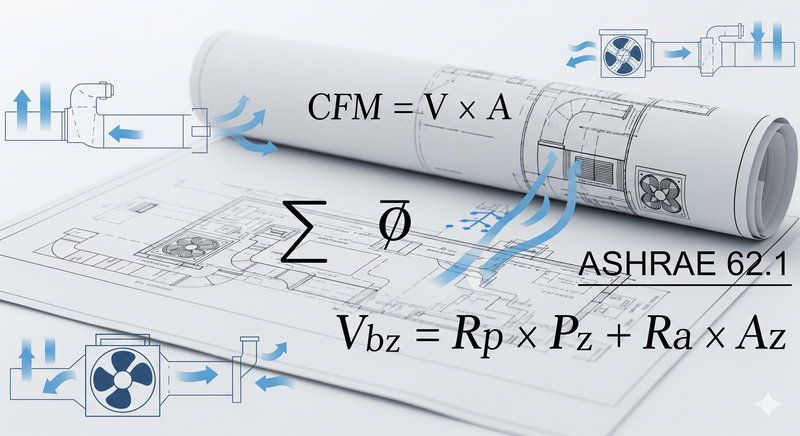
For each zone, use Equation 6-1 to calculate the breathing zone ventilation rate:
Where:
How to do this properly:
Note: Always verify whether default occupant density is permitted for your project jurisdiction.
Next, correct for air distribution effectiveness using Equation 6-2:
Where:
Ez depends on:
If Ez is different for heating and cooling modes, make sure to use the lower value for each zone. If Ez < 1.0, your required outdoor airflow increases.
Before proceeding, classify your system:
This determines whether system ventilation efficiency must be calculated.
Note: For Single Zone systems and 100% Outdoor Air systems, skip to step 7
This is where many calculations go wrong. First, calculate occupant diversity (D) of your multi-zone system using Equation 6-6:
Where:
Occupant diversity takes into account the potential double counting of occupants when counting up the population of each zone. For example, and office space may have offices and a lunch room. Each office and the lunch room would all have a zone population (Pz), however the occupants in the offices would be the same people in the lunch room - they would occupy different spaces at different times in the day. It would be inaccurate to add the occupancy values of the lunch room and offices as unique occupants.
The uncorrected outdoor air intake (Vou) is calculated using Equation 6-5:
The next step is to calculate System Ventilation Efficiency (Ev) using Equations 6-7 and 6-8:
for
for
The system efficiency takes into account any potential loss of efficiency in distributing outdoor air when the diversity factor has been applied.
For a Multi-zone Recirculating System,the outdoor air intake value (Vot) can then be calculated with Equation 6-10:
This is the ultimate value for the outdoor air that your air handling unit will need to take in.
For a Single-Zone System, use Equation 6-3:
You’re done. No system ventilation efficiency correction is needed - your system ventilation intake (Vot) is equal to Voz.
For a 100% Outdoor Air System, use Equation 6-4:
This is similar to a single zone system, except that you must now take the sum of all zone outdoor airflows.
For multi-zone recirculating systems, since the relative values of outdoor air to primary (conditioning) air may change for each zone, there is one last step to ensure each zone gets the outdoor air it needs. For each zone, calculate the minimum primary airflow rate (Vpz-min) using Equation 6-9:
For single zone and 100% outdoor air systems this step is not necessary.
The VRP determines minimum outdoor intake, but you must also:
Outdoor intake may need to exceed VRP minimum to balance exhaust.
Make sure you’re aware of the ventilation requirements for your specific project and in your specific jurisdiction. While ASHRAE 62.1 is used across most of the world, some authorities may enforce alternative ventilation standards or different versions of 62.1.
Some projects such as healthcare and laboratories have alternative requirements for fresh air, air change rates, or pressurization. Make sure you have all the information you need for your specific project prior to starting your ventilation calculations.
The Ventilation Rate Procedure in ASHRAE 62.1–2022 is methodical — but only if you follow the sequence correctly. The most important mindset shift is this: You are not calculating outdoor air once — you are calculating it at the zone level, correcting it at the system level, and validating it against system behaviour.
When done properly, the VRP ensures:
If you approach it zone-by-zone and stay disciplined about the order of operations, the process becomes straightforward — even for large, complex multi-zone systems.